What to Expect on a Djerba Desert Tour
The honest shape of a desert day from Djerba: the 6am pickup, how much of it is driving, what the stops are really like, what to pack, and what tends to go wrong.
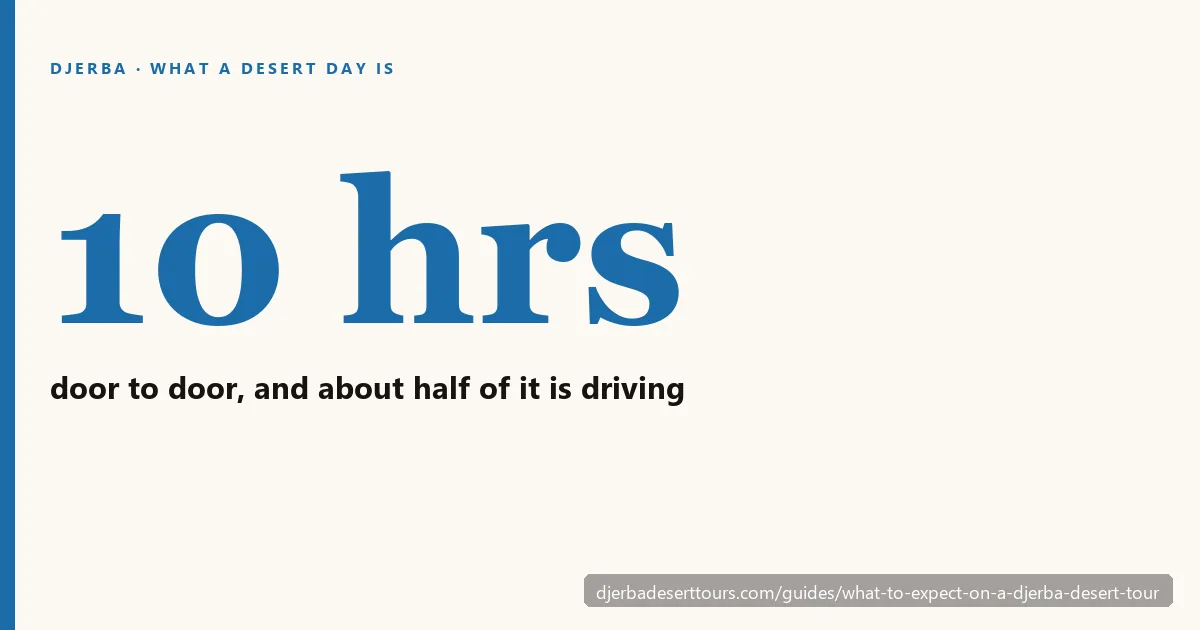
Almost every disappointed review of a Djerba desert tour is about the same thing, and it is never the desert. It is the hours. A day trip from this island is ten to eleven hours door to door and around half of that is spent in a vehicle — not because anything is padded, but because the sand is genuinely four hours away. Everything below is written so that number is not a surprise on the morning.
Check Availability
The short version
Ten to eleven hours. A 6am or 7am pickup from your hotel door. Four or five stops of twenty to ninety minutes each, one long stop in the middle, and an unbroken drive home.
Lunch is included on essentially every itinerary. The camel ride is not.
Where the hours go
Roughly five of them are driving. The rest divides into one substantial stop — three hours at the Ksar Ghilane oasis on the most-reviewed tour — and a handful of short ones at ksour, villages and viewpoints.
That ratio is the whole trip, and it does not change between operators.
The day, hour by hour
Before 6am. Be at the door, not in the lobby. Pickups run from about 6am for the Ksar Ghilane routes and 7am for the Tataouine ones, and the operator confirms your window the evening before rather than at booking. Hotels on the far side of the island are collected first, so your slot may be earlier than your neighbour’s.
The first ninety minutes. The causeway at El Kantara and the run inland toward Medenine. Nothing happens. Sleep.
Mid-morning. A coffee stop, then the climb onto the Dahar plateau. From here the day becomes a sequence of twenty-to-thirty-five-minute halts: a ksar, a ridge village, a viewpoint. This is the part that varies most between itineraries.
Early afternoon. On the sand routes, the asphalt gives out past Beni Kheddache and the last stretch is desert track. Then the long stop — three hours at Ksar Ghilane on the most-reviewed tour, an afternoon on the others. Lunch is somewhere in here and is included on essentially every itinerary.
Evening. The return is unbroken. Most guests reach their hotel between 7pm and 9pm.
What the stops are actually like
Ksar Ghilane exceeds expectations more often than anything else here. The pool is warm, it is genuinely swimmable, and fifty metres past the last tent there is nothing in any direction. In high season there are people in the water; the reviews that mention that still rate the stop highly.
Chenini is steeper than the listings imply. Thirty to forty minutes climbing uneven rock in full sun, and about forty Amazigh families still live along those paths. It is the single stop that rules the day out for some travellers.
Matmata is often too short. The pit dwellings and the Sidi Driss film set deserve more than the twenty minutes some routes give them, which is why a Matmata-anchored itinerary exists.
The ksour photograph better than they read. Ksar Ouled Soltane in particular is extraordinary in person and unremarkable in a listing description.
What to pack
- Swimsuit and towel if Ksar Ghilane is on the route. Nothing on site hires either out, and this is the most common regret in the reviews.
- Closed walking shoes, not sandals. Chenini and the ksour are loose rock.
- Sun hat, sunglasses, sunscreen. There is no shade at any of the desert stops.
- Cash in dinars. Camel rides, quad rides, the tip at the Berber family visit, market purchases and drinks are all cash and all extra.
- A warm layer, November to March, and non-negotiably so if you are camping.
- Your own water beyond whatever the tour provides, which on most is half a litre.
What tends to go wrong
The camel ride is not included. It almost never is, on any itinerary, and guests regularly arrive expecting otherwise. Same for quads.
Site entries are sometimes extra. Ksar Hadada and Sidi Driss charge at the gate. Two of the eleven tours here include them.
Timings move. Weather, traffic and how busy a stop is all shift the schedule, and the sunset itineraries are explicitly conditions-dependent. Operators say so in their own terms.
The vehicle matters more than people expect. The routes that reach sand run 4x4s because the last stretch is track. If rough driving is a problem, the surfaced-road day covers the same villages without it.
Is it worth it?
If the alternative is a day on a good beach, be honest about what you are trading: ten hours, half of them seated, for a few hours of somewhere genuinely unlike anywhere on the coast. Most people who go say yes and a minority say no, and the split tracks almost exactly with whether they knew the hours in advance.
The way to tilt it is to take an overnight instead, where the same driving buys sunset, a night under an unlit sky, and sunrise — or to pick the route that matches what you actually want rather than the cheapest one on the page.
The Sahara, and Back to Your Hotel by Dark
Hotel pickup across Djerba and Zarzis, a 4x4 over the Dahar, the hot spring at Ksar Ghilane and lunch — rated 4.8/5 by 1,671 guests. Free cancellation up to 24 hours before.
Check Availability & Book